What Is Asynchronous Work? A Practical Explainer
Cut meetings and boost focus with asynchronous work. Learn what async work really means, why remote teams need it, and how to get started.
What It Really Means
When a team works asynchronously, nobody expects an instant reply. Rather than gathering everyone in a room or on a video call to talk things out live, people move projects forward on their own schedules. Information gets written down or recorded so teammates can pick it up whenever they log on, without missing a beat. You hear the phrase constantly whenever remote work comes up, but people misuse it all the time. Working from home doesn't make your company async by default, nor does taking an async approach mean you never talk to your coworkers live again. Let's break down what the term actually covers in day-to-day work.
Sync vs. Async: The Core Difference
Traditional, synchronous work operates on a simple premise: everyone is online at the exact same moment, whether that's in a conference room, a live Slack thread, or a Zoom call. Async flips that premise entirely. It builds on the assumption that team members will catch up, weigh in, and deliver work whenever it fits their block of focus, often hours after a message was sent. A lot of distributed companies are still entirely synchronous under the hood. Their staff logs in at 9:00 AM sharp, back-to-back meetings clutter the calendar, and sending a chat message comes with an unwritten rule that you'll reply within three minutes. That is remote work, sure, but it isn't async. Adopting async isn't something that happens automatically when you give people laptops—it's a conscious decision about how a company coordinates daily effort.
The thread tying all of this together is documentation. Ideas and progress are recorded in places everyone can review later, instead of disappearing into a live conversation that happened while half the team was asleep.
Why It Matters So Much
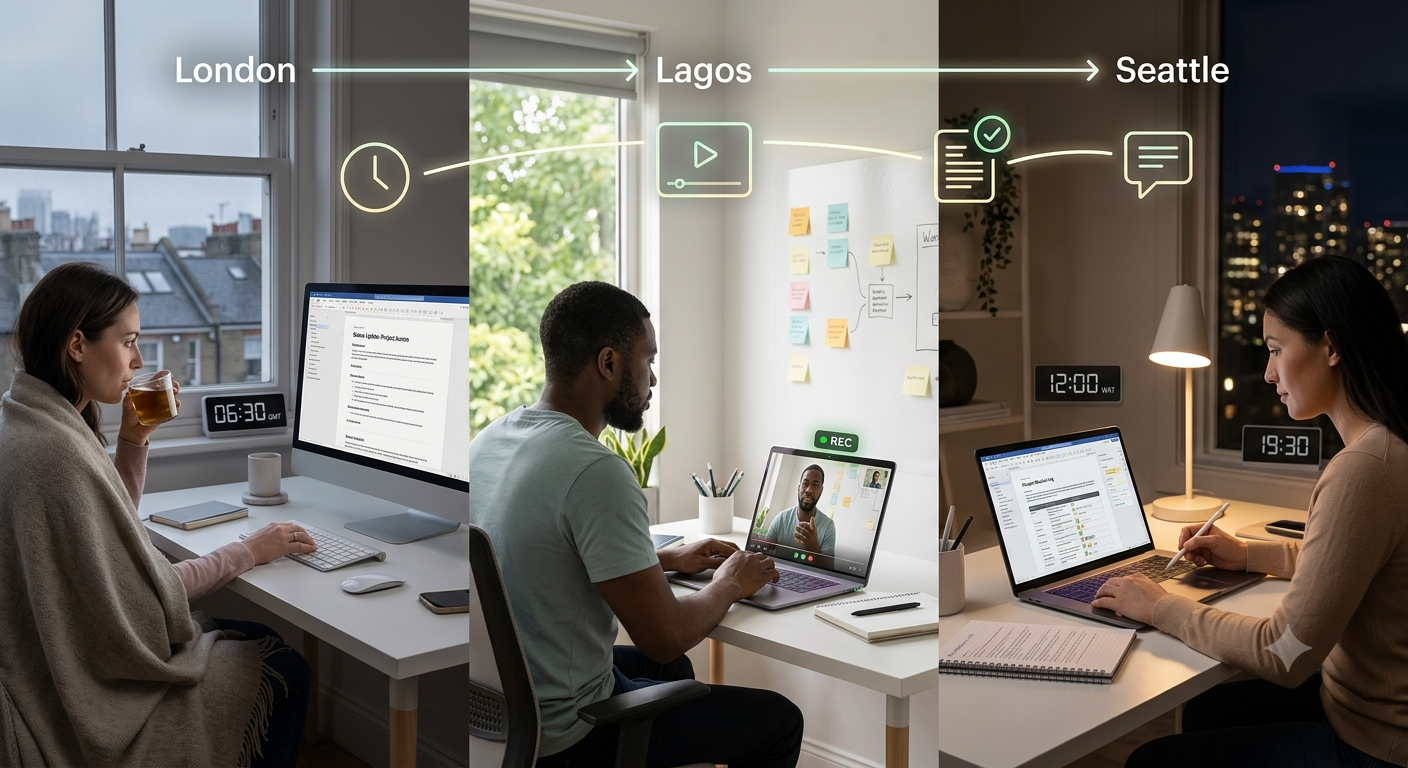
If your team spans multiple continents, synchronous coordination gets painful fast. Take a colleague in Lisbon and another in Manila: they might share two overlapping hours a day at best. If every decision requires a live sync, you end up eating away that precious window with status updates—or forcing someone to jump on a call at 6:00 AM or near midnight. Even if everyone lives in the same city, async habits yield massive benefits by protecting deep focus. When a team gets into the habit of writing down decisions and sending short update recordings, engineers, writers, and designers get back hours of uninterrupted time. They can actually dig into deep work rather than seeing their days sliced up by 30-minute status meetings.
How Async Works in Practice
You can't just buy software and suddenly become async. It's really about building consistent team habits.
• Written status updates: Swapping out the 15-minute morning standup for a bulleted post in a shared channel or document.
• Asynchronous video walkthroughs: Recording a quick video (with tools like Loom) so colleagues can watch a feature demo on their own schedule.
• Clear decision logs: Documenting choices, context, and reasoning in a public internal wiki rather than hoping people remember what was said in a verbal conversation.
• Setting clear response windows: Explicitly agreeing on rules like 'expect answers within one business day' so nobody feels paranoid about stepping away from Slack.
What Async Work Doesn't Do
It's worth being clear: async doesn't mean zero meetings. Sensitive conversations, performance feedback, chaotic brainstorming sessions, or tricky discussions where tone easily gets misconstrued still work far better over a live call. Forcing a delicate debate into a massive written thread usually leads to frustration, misunderstandings, and wasted effort.
Summary
Asynchronous work allows teams to collaborate on their own schedules without requiring real-time presence or instant replies. By relying on habits like written updates, short video walkthroughs, and decision logs, it protects focus time and helps distributed teams bridge time zones without eliminating live meetings entirely.
More in Remote Work
View allFrequently Asked Questions
Is asynchronous work just another name for remote work?
A: Usually you end up with fewer, though cutting meetings isn't the primary goal. It's really about trimming down those recurring updates that could easily be written down, keeping live calendar slots for discussions that genuinely benefit from real-time back-and-forth.
Does going async mean you stop having meetings?
A: Absolutely. Time zone differences aside, async practices—like documenting decisions or recording short video walkthroughs—cut down on constant daily interruptions. That gives everyone longer, uninterrupted blocks of time to focus on deep, meaningful work.
Newsletter placeholder
Future weekly technology brief
This block reserves a clean, non-intrusive location for a future newsletter without changing article layouts later.
Comments placeholder
A future comments system can be added here without changing the article template.