Best AI Research Tools for Students and Professionals
A practical roundup of top AI research tools that speed up literature reviews and source summaries while keeping citations accurate and verifiable.
Research used to mean spending half your day downloading PDFs, skimming dense abstracts, and trying to remember which paper made which point. Modern AI research tools have advanced to the point where they can shave hours off that process—whether you're a student building out a literature review or a professional getting up to speed on a new field. This guide focuses specifically on tools that cite their sources rather than generating plausible text out of thin air. When accuracy matters, verifiable links are non-negotiable.
How we chose these picks
We prioritized platforms that link directly back to original sources instead of relying purely on general training data. That transparency is what makes a research tool genuinely trustworthy. On top of that, we evaluated how effectively each platform handles multiple documents, how clear its summaries feel, and whether the free tier provides enough real-world utility beyond a quick demo.
Best Overall: Perplexity
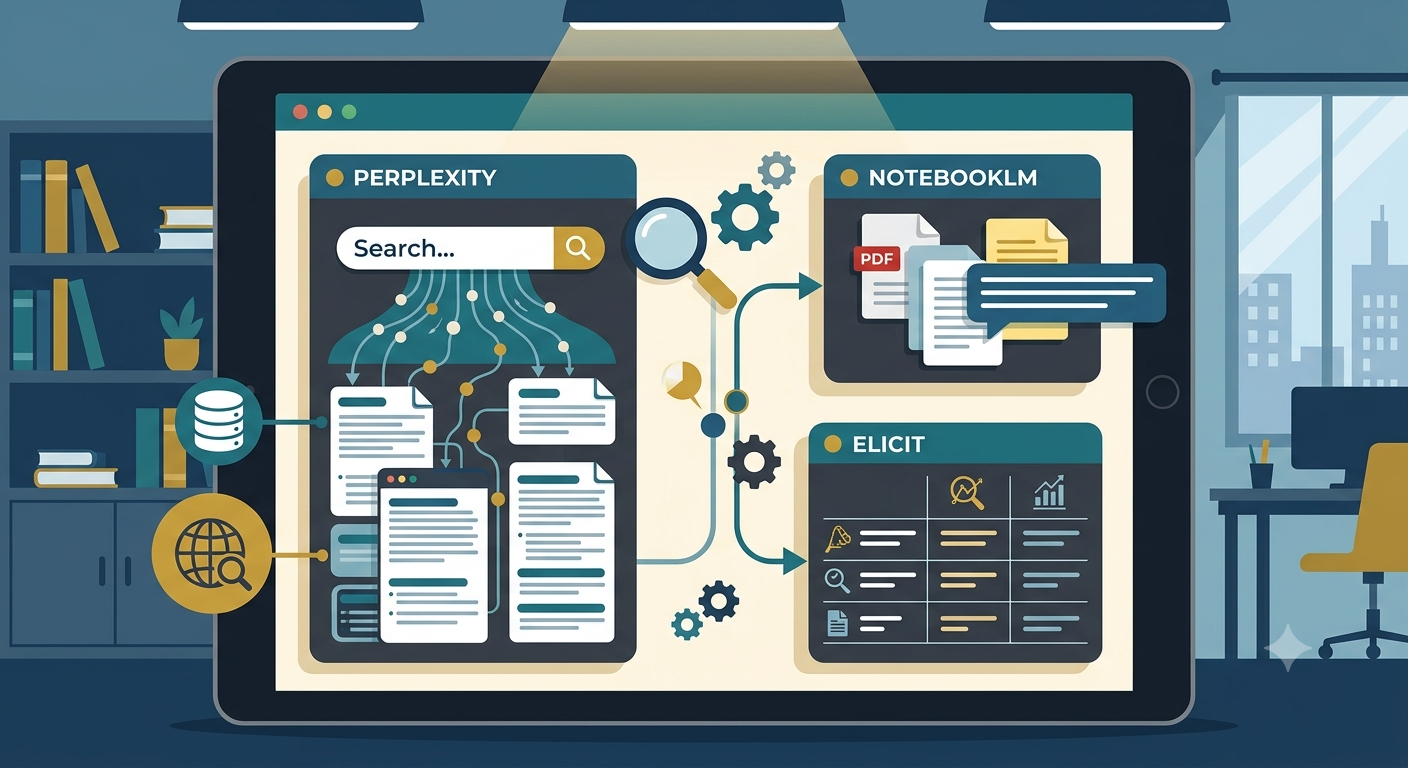
Perplexity functions like a hybrid between a modern search engine and a smart assistant. Ask a question, and it scans the web in real time, delivering a clear answer backed by direct citations. That combination makes it ideal when you need a fast starting point on a new topic alongside immediate source verification. It's particularly handy when stepping into unfamiliar territory, allowing you to follow citation links directly to primary sources rather than relying solely on the generated overview.
Best for Working with Your Own Sources: NotebookLM
Google's NotebookLM takes a completely different approach. Instead of searching the open web, it operates strictly on the documents, notes, or PDFs you upload. This makes it ideal for organizing course readings or synthesizing your own project materials without outside information cluttering the picture.
Because it stays locked within your provided files, the risk of introducing external claims or hallucinations drops dramatically—a crucial advantage when you need to stay strictly within a defined set of sources.
Best for Academic Literature Review: Elicit
Elicit was built from the ground up for analyzing academic literature at scale. Provide a research question, and it scans published scholarly databases, extracts core details like sample sizes, methodologies, and findings, and organizes them into a clear side-by-side layout. While it won't replace a careful read of the core papers essential to your work, it drastically cuts down the time spent determining which papers warrant that deeper read.
Best for Scientific Consensus: Consensus
Consensus operates like a search engine connected directly to a database of over 200 million academic papers. Rather than simply summarizing text, it analyzes peer-reviewed research to show you where the scientific community stands on a specific question.
When you search for a claim or hypothesis, Consensus aggregates conclusions from multiple studies and provides a visual breakdown—indicating whether the literature overwhelmingly agrees, disagrees, or remains inconclusive. It's an invaluable tool for quickly gauging scientific evidence without spending days reading individual abstracts.
Best for Citation Analysis and Credibility: Scite.ai
Traditional citation metrics only tell you how many times a paper has been cited, not why. Scite.ai solves this by introducing Smart Citations, which analyze the context around each reference.
It classifies citations into three categories: those that support the paper's findings, those that contrast them, and those that simply mention the work. This makes it much easier to judge whether a study's conclusions still hold weight or if subsequent researchers have challenged them.
Building an AI-Powered Research Workflow
Instead of relying on a single tool, combining several platforms creates a streamlined research process that saves time while preserving academic rigor:
Initial Exploration: Start with Perplexity or Consensus to get a broad overview of your topic and identify key research questions.
Deep Literature Mapping: Move to Elicit to run structured searches, extract methodologies, and highlight major studies across published literature.
Credibility Verification: Use Scite.ai to inspect how other researchers have cited your primary sources and confirm their conclusions remain valid.
Focused Synthesis: Upload your selected PDFs to NotebookLM to chat directly with your library, pull key quotes, and outline your final draft.
Summary
If you need a versatile, everyday research companion, Perplexity's cited web searches make it the best starting line. If you're analyzing a specific set of documents you already own, NotebookLM keeps answers strictly bound to your files. And if you're conducting a formal academic literature review, Elicit's structured paper comparisons are tough to beat. Regardless of which option you choose, treat AI-generated summaries as an efficient filter to discover what's worth reading closely—not as a substitute for doing the reading yourself.
More in Artificial Intelligence
View allFrequently Asked Questions
Can I trust the citations AI research tools give me?
A1: Tools that anchor their answers in real, retrievable documents and point you straight to the source are far more reliable than a standard chatbot working off memory. Even so, it pays to click through and double-check. Every now and then, a tool might misinterpret a point or quote something out of context, which is the last thing you want in your own writing.
Are these tools a replacement for reading the actual papers?
A2: When you're sifting through dozens of papers just to get your bearings, absolutely—they save an incredible amount of time. But once you narrow down the key studies for a thesis, journal submission, or strategic report, there's still no substitute for reading the full text yourself.
Newsletter placeholder
Future weekly technology brief
This block reserves a clean, non-intrusive location for a future newsletter without changing article layouts later.
Comments placeholder
A future comments system can be added here without changing the article template.