What Is an AI Hallucination? A Plain-English Explainer
A clear guide to AI hallucinations: what they are, why models generate false facts, and how to verify information before using it.
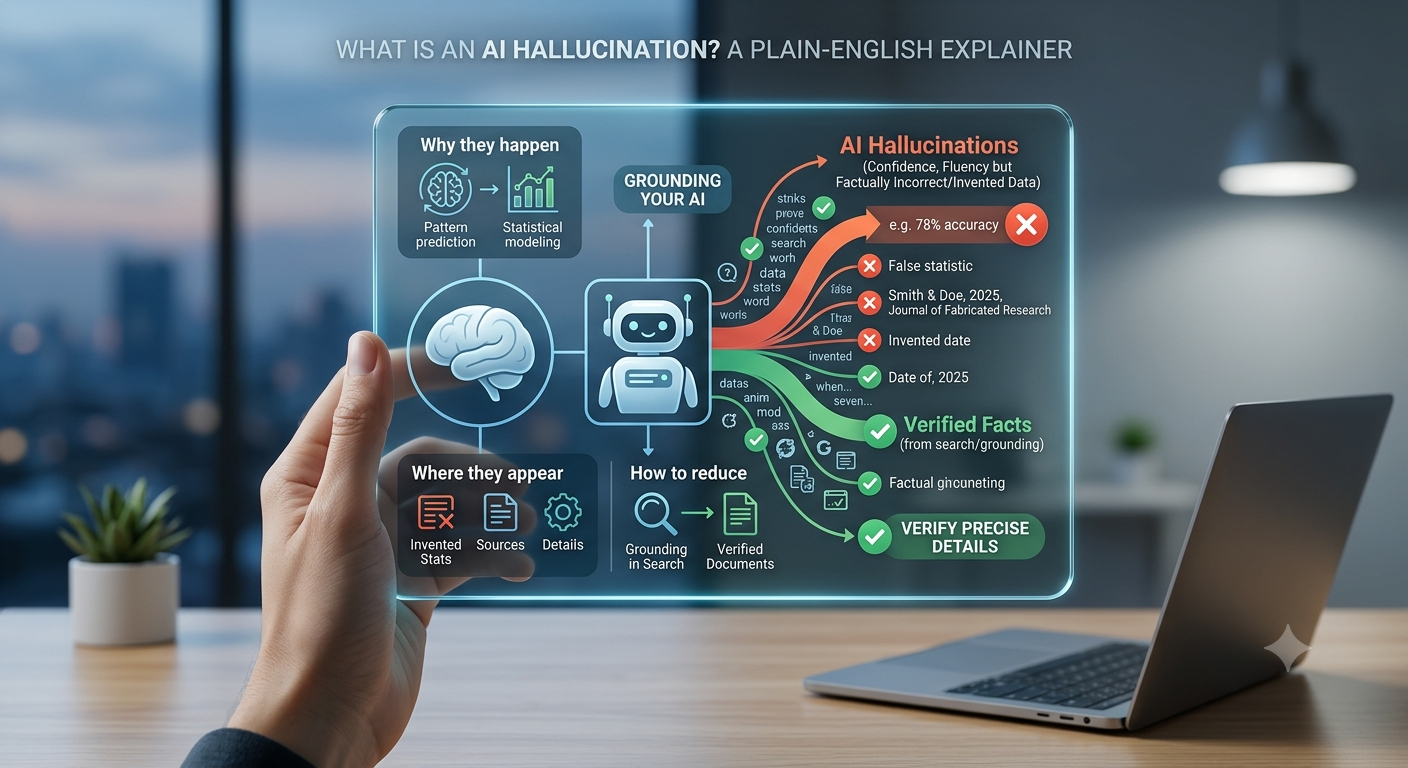
An AI hallucination is when an AI model states something false with the same confident, fluent tone it uses for things that are true. It might invent a study that doesn't exist, cite a source that was never published, or state a statistic that sounds precise but was never verified. The term stuck because the output isn't garbled or obviously wrong, it's just confidently made up. If you've used an AI chatbot for research or writing, you've likely run into this at least once. Understanding why it happens makes it much easier to spot and work around.
What it is
A hallucination isn't a technical glitch in the traditional sense, like a crash or an error message. It's a side effect of how these models generate text in the first place. A language model produces its response one piece at a time, predicting what's statistically likely to come next based on patterns learned from enormous amounts of text, not by looking answers up in a verified database unless it's specifically using a tool built for that. When the model doesn't have strong, reliable information about something, it doesn't reliably know that it doesn't know. Instead, it tends to keep generating fluent, plausible-sounding text, because sounding coherent is what it was trained to do well.
Why it matters
The practical risk shows up whenever specific, checkable facts matter: a legal brief, a research summary, a news article, a medical question. A fabricated citation looks exactly like a real one until someone tries to find it. An invented statistic reads just as confidently as a correct one. This becomes a bigger issue the more an AI tool is used for tasks where accuracy has real consequences, which is a growing share of how people actually use these tools day to day.
How it works
Underneath the conversation, a model is essentially completing a very sophisticated pattern: given everything so far, what's the most statistically reasonable next word? For common, well-documented topics, that process tends to produce accurate answers, because the correct information showed up often and consistently in what the model learned from. For obscure, ambiguous, or highly specific questions, like an exact citation or a niche statistic, the model may not have reliable patterns to draw from, but it still generates something, because stopping to say “I don't actually know” wasn't the behavior it was most strongly trained toward.
What it does not do
A hallucination doesn't mean the AI is being deceptive on purpose. There's no intent behind it in the way there is when a person lies; the model has no internal sense that it's stating something false. It also doesn't mean every answer from that tool is unreliable. Most everyday questions, especially about common knowledge or well-established topics, get answered accurately.
Summary
Repeat the An AI hallucination is confident, fluent output that turns out to be false, and it happens because language models generate statistically likely text rather than looking up verified facts by default. It shows up most often in fabricated citations, invented statistics, and specific details stated with false precision. The most useful habit is treating specific, checkable claims from any AI tool as a starting point rather than a finished answer, especially anything you plan to use in professional or published work. Grounding tools like search reduce the problem, but a quick independent check on anything precise still goes a long way.
More in Artificial Intelligence
View allFrequently Asked Questions
Does an AI hallucination mean the AI is lying?
No. Lying implies knowing the truth and choosing to say something else. A hallucination happens because the model is generating statistically likely text, without a built-in way to verify facts unless it's actively using a tool like search.
How can I tell if an AI's answer might be a hallucination?
A2: Be most cautious with specific, checkable details: exact statistics, direct quotes, citations, dates, and names. Those are the details most worth verifying independently, especially for anything you'll use in professional or published work.
Newsletter placeholder
Future weekly technology brief
This block reserves a clean, non-intrusive location for a future newsletter without changing article layouts later.
Comments placeholder
A future comments system can be added here without changing the article template.