What Is Parkinson's Law and How It Affects Deadlines
A practical breakdown of Parkinson's Law: why work expands to fill available time, how it impacts your deadlines, and when pushing tighter timelines actually backfires.
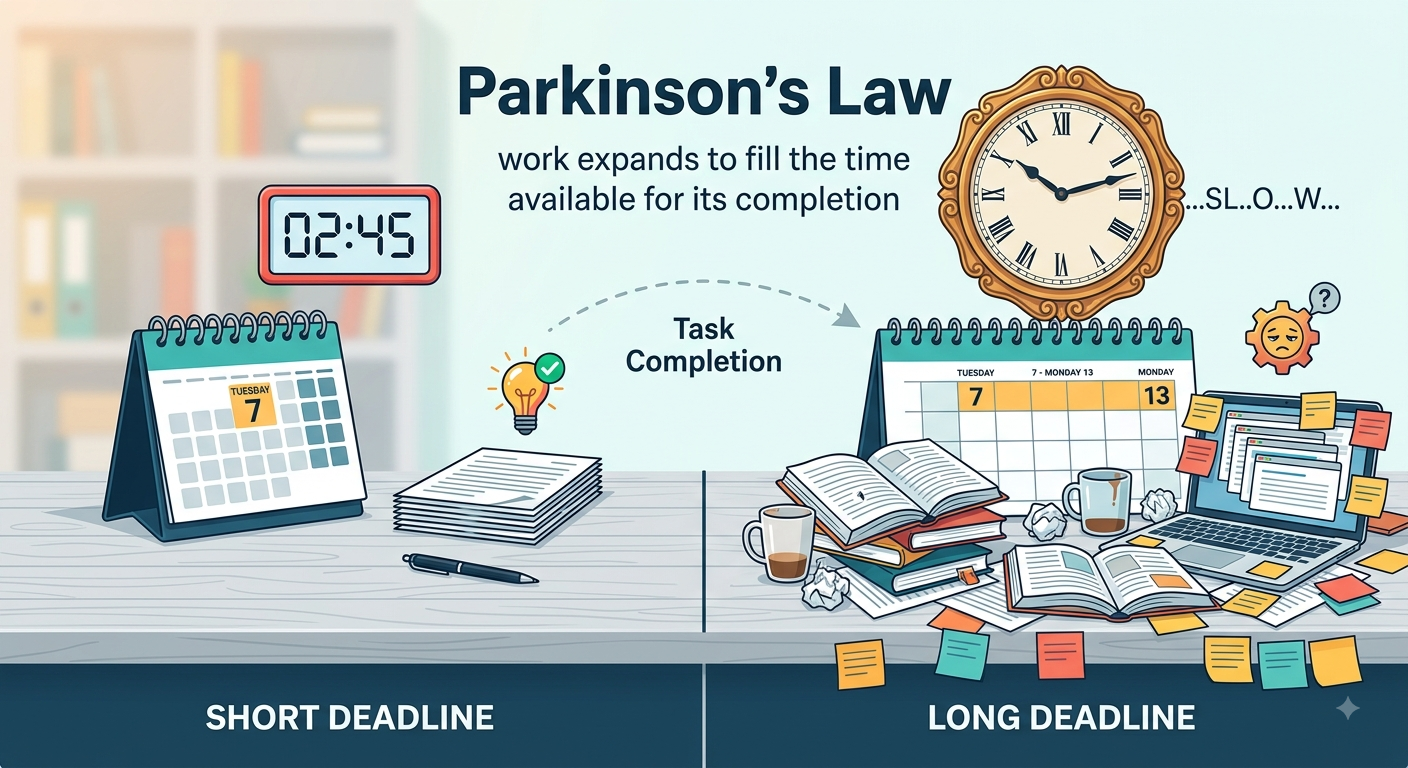
Give yourself a whole week to draft a simple two-page memo, and somehow it’ll take every bit of those seven days. Give yourself just a single afternoon, and you'll likely hand in something just as sharp before dinner. That, in a nutshell, is Parkinson's Law: work expands to fill the time allotted for its completion. Back in 1955, historian Cyril Northcote Parkinson coined the phrase in a satirical essay poking fun at British bureaucratic bloat. While it wasn't born as a formal academic theory, it hit on something so instantly recognizable that it became a standard anchor in time management—especially for anyone steering their own daily workflow.
What it is
Strip away the organizational jargon, and the underlying dynamic is straightforward: the time you reserve for a task dictates how long it actually takes far more than the task's true difficulty does. Hand a basic project a broad deadline, and it quietly absorbs every extra hour. It fills that space with unnecessary polish, endless tweaking, or simply good old-fashioned procrastination. It isn't that you're sitting around doing nothing during those extra days. Rather, your effort, internal hesitations, and perceived complexity swell up to match whatever container you've built on your calendar.
Why it matters
This pattern hits hardest when you manage your own schedule—a reality for freelancers, remote workers, and anyone operating without a manager hovering over their desk. Without a firm external force holding a task in place, something that really only requires two hours can easily stretch out into an all-day affair. Once you recognize this tendency, though, you gain real leverage. Choosing tighter, deliberate deadlines forces a task back down to what it actually requires, stopping work from inflating simply because the clock allows it.
How it works
In day-to-day work, this timeline stretch happens in subtle ways. You might catch yourself making endless rounds of edits on a draft that was already solid, re-evaluating decisions you made hours ago, or delaying the starting line until the approaching deadline finally creates enough urgency to act. None of this means the task suddenly got harder—it just means the available window gave you room to overcomplicate it.
What it does not do
Parkinson's Law isn't an excuse to compress every single deadline down to the wire. Tasks that demand deep, uninterrupted focus—like complex research, intricate software design, or strategic planning—depend heavily on depth of thought. Slashing timelines indiscriminately on these types of work won't make you more efficient; it will just wreck the
Summary
Parkinson's Law highlights a basic truth about how we work: tasks tend to stretch across whatever timeline we assign them, especially when deadlines are flexible or self-imposed. Deliberately setting shorter timeframes and breaking large goals into smaller milestones can pull work back to its true size. However, applying this heavy-handedly to deep, creative work will quickly backfire. A practical next step: take one recurring item on your schedule this week and cut its usual allotted time by a noticeable margin. Watch what happens. If the quality holds steady, you've just reclaimed hours you were previously giving away for free.
More in Productivity
View allFrequently Asked Questions
Is Parkinson's Law a scientifically proven rule?
Not in a strict laboratory sense. It began as a sharp observation in a 1955 essay rather than a peer-reviewed psychological trial. Still, it captures a behavioral pattern that almost anyone managing their own workload recognizes immediately.
Does shortening every deadline automatically make me more productive?
Not across the board. It works wonders for tasks with clear boundaries and flexible polish. But if you push aggressive deadlines on work that genuinely requires deep, quiet reflection, you'll usually end up hurting the final result.
Newsletter placeholder
Future weekly technology brief
This block reserves a clean, non-intrusive location for a future newsletter without changing article layouts later.
Comments placeholder
A future comments system can be added here without changing the article template.